Leave A Message
If you are interested in our products and want to know more details,please leave a message here,we will reply you as soon as we can.


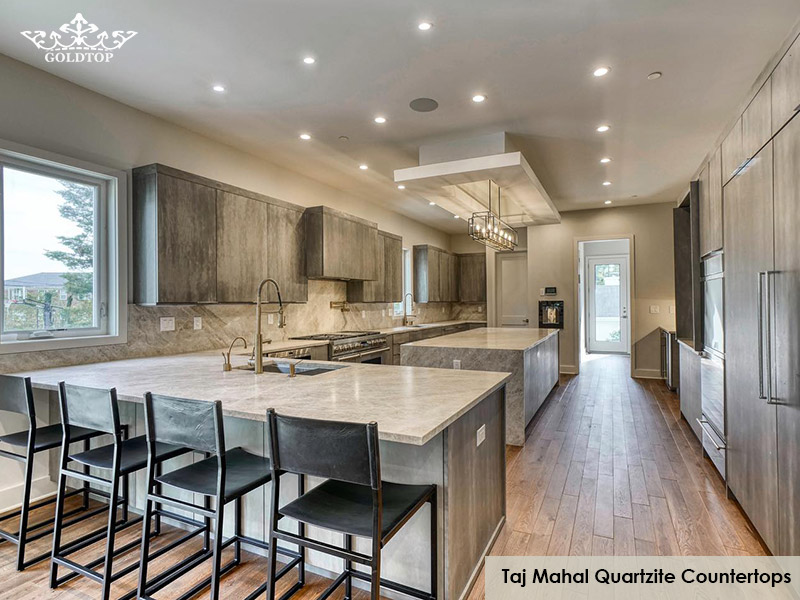
Stone countertops play an important role in residential, hospitality, multifamily, and commercial projects. Beyond appearance, a successful countertop project depends on proper planning, accurate measurements, material selection, fabrication quality, and installation.
Whether you are a homeowner, contractor, developer, designer, or distributor, understanding the countertop customization process can help reduce project risks and improve final project outcomes.
This guide covers the most common kitchen countertop and bathroom vanity top types, customization processes, important buying considerations, and the differences between sourcing from a China factory and purchasing locally.
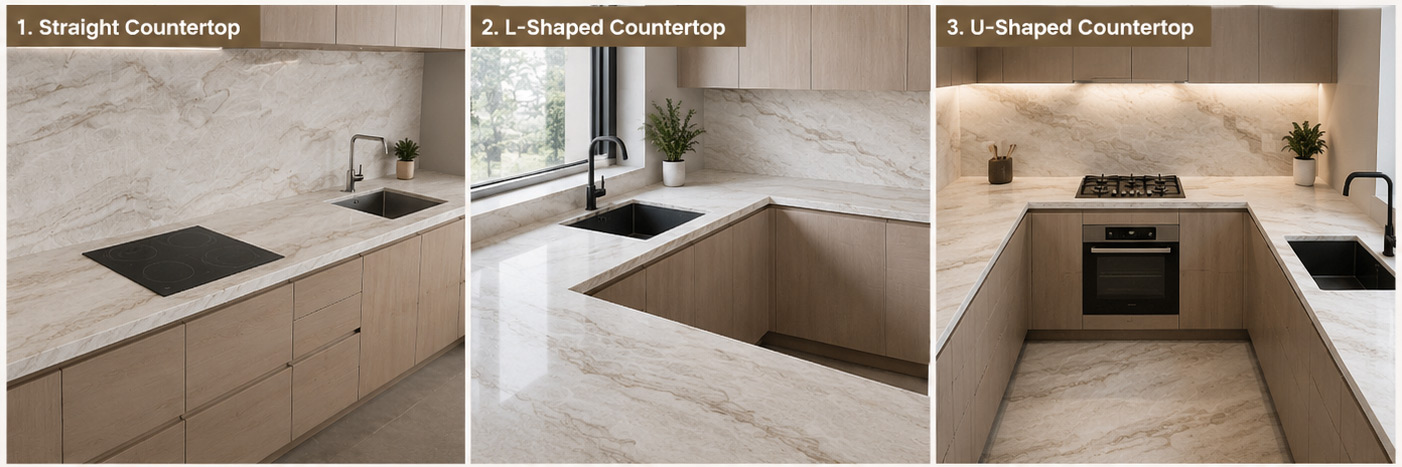
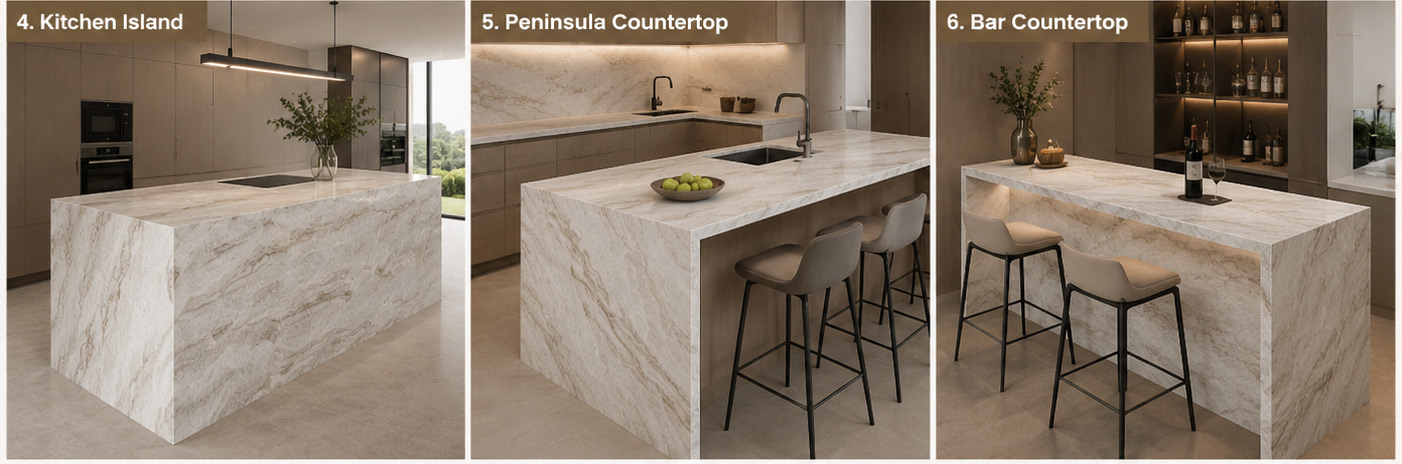
Different kitchen layouts require different countertop configurations. Choosing the right layout can improve workflow, maximize available space, and enhance the overall appearance of the kitchen.
| Countertop Type | Features | Common Applications | Advantages |
|---|---|---|---|
| Straight Countertop | Single-wall layout | Apartments, small homes, rental projects | Simple installation and cost-effective |
| L-Shaped Countertop | Two connected countertop sections | Residential kitchens and open-plan layouts | Efficient workflow and additional workspace |
| U-Shaped Countertop | Three-sided countertop design | Large homes and villas | Maximum workspace and storage |
| Kitchen Island | Independent countertop section | Open kitchens and luxury residences | Adds preparation, dining, and social space |
| Peninsula Countertop | Connected to the main cabinet run | Apartments and medium-sized kitchens | Improves functionality while saving space |
| Double Island | Two independent islands | Luxury homes and large villas | Clear functional zoning and premium appearance |
| Bar Countertop | Extended countertop seating area | Modern homes and commercial spaces | Creates a casual dining and gathering space |
Large kitchen islands with waterfall edges remain one of the most popular design features in North America, Australia, and Europe.
Common functions include: ◆ Food preparation ◆ Dining areas ◆ Entertaining guests ◆ Open-concept living spaces
Quartzite, marble, and engineered quartz are frequently selected for large islands because of their durability and visual impact.
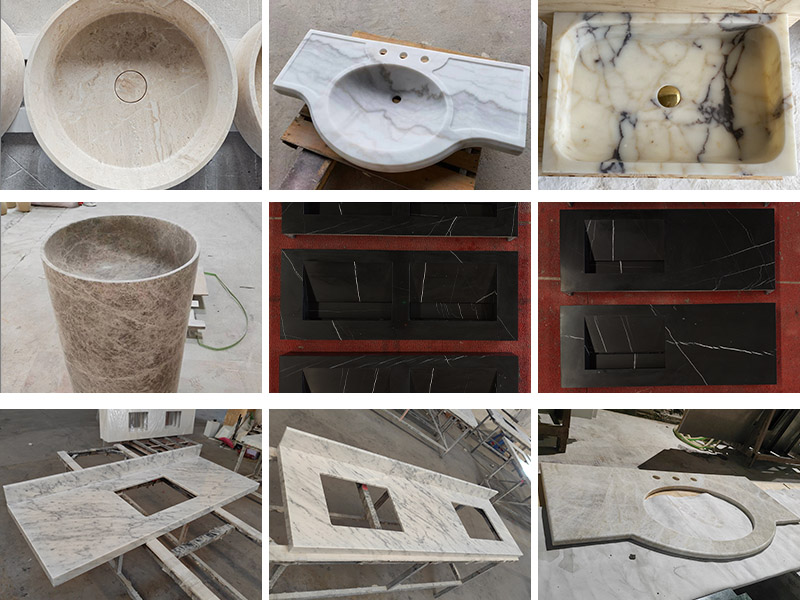
Bathroom vanity tops are typically categorized by sink installation style, user requirements, and backsplash design.
| Type | Features | Common Applications | Advantages |
|---|---|---|---|
| Vessel Sink Vanity Top | Sink sits above the countertop | Hotels, luxury residences, retail spaces | Strong visual impact |
| Undermount Sink Vanity Top | Sink installed beneath the countertop | Residential bathrooms and apartments | Easy cleaning and seamless appearance |
| Integrated Sink Vanity Top | Countertop and sink fabricated as one unit | Luxury hotels and high-end homes | Minimal joints and easy maintenance |
| Semi-Recessed Sink Vanity Top | Sink partially recessed into the countertop | Compact bathrooms | Space-saving design |
| Drop-In Sink Vanity Top | Sink rim rests on the countertop surface | Budget-conscious residential projects | Easy installation |
| Type | Typical Size | Applications | Advantages |
|---|---|---|---|
| Single Vanity | 24"–48" | Guest bathrooms and apartments | Compact and economical |
| Double Vanity | 60"–96" | Master bathrooms and villas | Allows simultaneous use |
| Triple Vanity | 96"+ | Hotels and luxury residences | Suitable for multiple users |
| Type | Features | Common Applications |
|---|---|---|
| No Backsplash | Minimalist appearance | Contemporary bathrooms |
| Standard Backsplash | Rear splash protection | Most residential projects |
| Side Splash + Backsplash | Rear and side protection | Hotels and commercial spaces |
| Full Height Backsplash | Stone extends up the wall | Luxury residential projects |
A professional countertop project typically follows the workflow below:
| Step | Process | Key Points |
|---|---|---|
| 1 | Material Selection | Confirm color, thickness, and finish |
| 2 | Drawing Submission | Provide CAD drawings or dimensioned layouts |
| 3 | Quotation Approval | Confirm pricing and project scope |
| 4 | Slab Layout Confirmation | Review vein direction and seam locations |
| 5 | Fabrication | Cutting, edging, polishing, and cutouts |
| 6 | Quality Inspection | Verify dimensions and surface quality |
| 7 | Packing & Shipping | Export-grade wooden crate packaging |
| 8 | Installation | Install according to approved drawings |
Bathroom vanity tops follow a similar process but require additional attention to sink and faucet details.
| Step | Process | Key Points |
|---|---|---|
| 1 | Material Selection | Choose stone type, color, and finish |
| 2 | Sink Selection | Vessel, undermount, or integrated sink |
| 3 | Drawing Submission | Provide vanity dimensions |
| 4 | Cutout Confirmation | Confirm faucet and drain locations |
| 5 | Layout Approval | Review slab appearance and vein direction |
| 6 | Fabrication | Cutting, edging, and sink cutouts |
| 7 | Inspection | Verify dimensions and finish quality |
| 8 | Packing & Shipping | Label and package for installation |
| 9 | Installation | Final site installation |
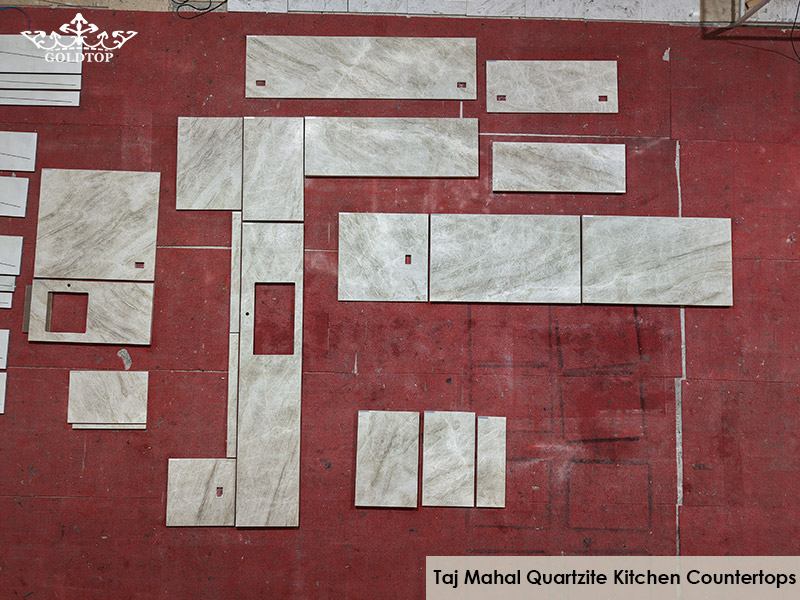
Marble, quartzite, granite, and travertine are natural materials. Variations in color, veining, and crystal structure should be expected. Reviewing actual slab photos before fabrication helps avoid unexpected results.
Popular edge profiles include: ◆ Eased Edge ◆ Pencil Edge ◆ Beveled Edge ◆ Bullnose Edge ◆ Mitered Edge
The edge profile can significantly influence the final appearance of the countertop.
Incorrect cutout dimensions can lead to installation issues, production delays, and additional costs. Providing actual sink specifications is highly recommended.
For oversized kitchen islands and large countertop sections, confirm: ◆ Elevator dimensions ◆ Stair access ◆ Door openings ◆ Site handling requirements
Large pieces may require seam planning before production.
Many installation challenges originate from wall conditions rather than the countertop itself.
Confirm: ◆ Backsplash height ◆ Wall flatness ◆ Electrical outlet locations ◆ Window sill details
before production begins.
To maintain the appearance of marble countertops:
◆ Use stone-safe cleaners
◆ Avoid prolonged exposure to acidic substances
◆ Reapply sealers when necessary
Regular maintenance helps preserve the stone's beauty over time.
One of the most common purchasing decisions for developers, distributors, and contractors is whether to source countertops directly from a manufacturer or purchase locally.
| Comparison | China Factory | Local Supplier |
|---|---|---|
| Material Selection | Excellent | Moderate |
| Color Options | Excellent | Moderate |
| Custom Fabrication | Excellent | Moderate |
| Project Experience | Excellent | Moderate |
| Cost Efficiency | Excellent | Moderate |
| Small Orders | Moderate | Excellent |
| Lead Time | Moderate | Excellent |
| Site Measurement | No | Yes |
| Installation Service | No | Yes |
| Hotel Projects | Excellent | Moderate |
| Commercial Rollouts | Excellent | Moderate |
◆ Importers ◆ Stone distributors ◆ Contractors ◆ Developers
◆ Hotel projects ◆ Chain retail projects ◆ Multifamily developments
◆ Homeowners ◆ Small renovation projects
◆ Projects requiring field measurements
◆ Projects with urgent installation schedules
A successful countertop project involves much more than selecting a beautiful slab.
Material selection, layout approval, fabrication quality, inspection procedures, packaging, and installation planning all play critical roles in the final result.
Before placing an order, it is recommended to confirm:
✓ Stone material
✓ Countertop layout
✓ Sink configuration
✓ Edge profile
✓ Cutout dimensions
✓ Actual slab appearance
✓ Layout approval
✓ Packaging requirements
Taking time to review these details can significantly reduce project risks and improve overall project outcomes.
↗ How to Design a Stone Kitchen Island? Real Project Ideas & Layout Tips
↗ 2026 Quartzite Trends: What Are the Most Popular Quartzite Colors & Styles?
↗ 2026 Grey Marble Trends: Real Project Insights + Top 10 Recommended Stones
↗ Taj Mahal Quartzite vs. Taj Mahal Quartz: Key Differences, Pros & Which One to Choose



 IPv6 network supported
 Your Language
 français
 Deutsch
 русский
 italiano
 español
 العربية
 日本語
日本語 한국의
한국의 中文
中文